> For the complete documentation index, see [llms.txt](https://broadcast.presidiocreative.com/llms.txt). Markdown versions of documentation pages are available by appending `.md` to page URLs; this page is available as [Markdown](https://broadcast.presidiocreative.com/products/product-pages/size-charts.md).
# Size charts
Display different size charts on product pages
Broadcast includes a feature to display a custom size chart for any product you sell or a single size chart for all products when using the default product template:
### Adding size charts to your store
For stores that require multiple size charts, Broadcast offers the ability to associate each product with a unique and specific size chart. For example, an apparel shop can have separate size charts for women's and men's products. Each product can be linked to help the customer find the right size chart.
Other stores might only need one size chart for all their products. The setup for this kind of situation is very straightforward.
For multiple size charts, Broadcast uses product metafields to assign each product to a specific size chart. We'll walk you through the necessary setup steps below.
{% hint style="success" %}
Broadcast uses product metafields to display a unique Size chart on each product page. This allows you to create multiple size charts and assign them to different products in your store.
{% endhint %}
## How to set up
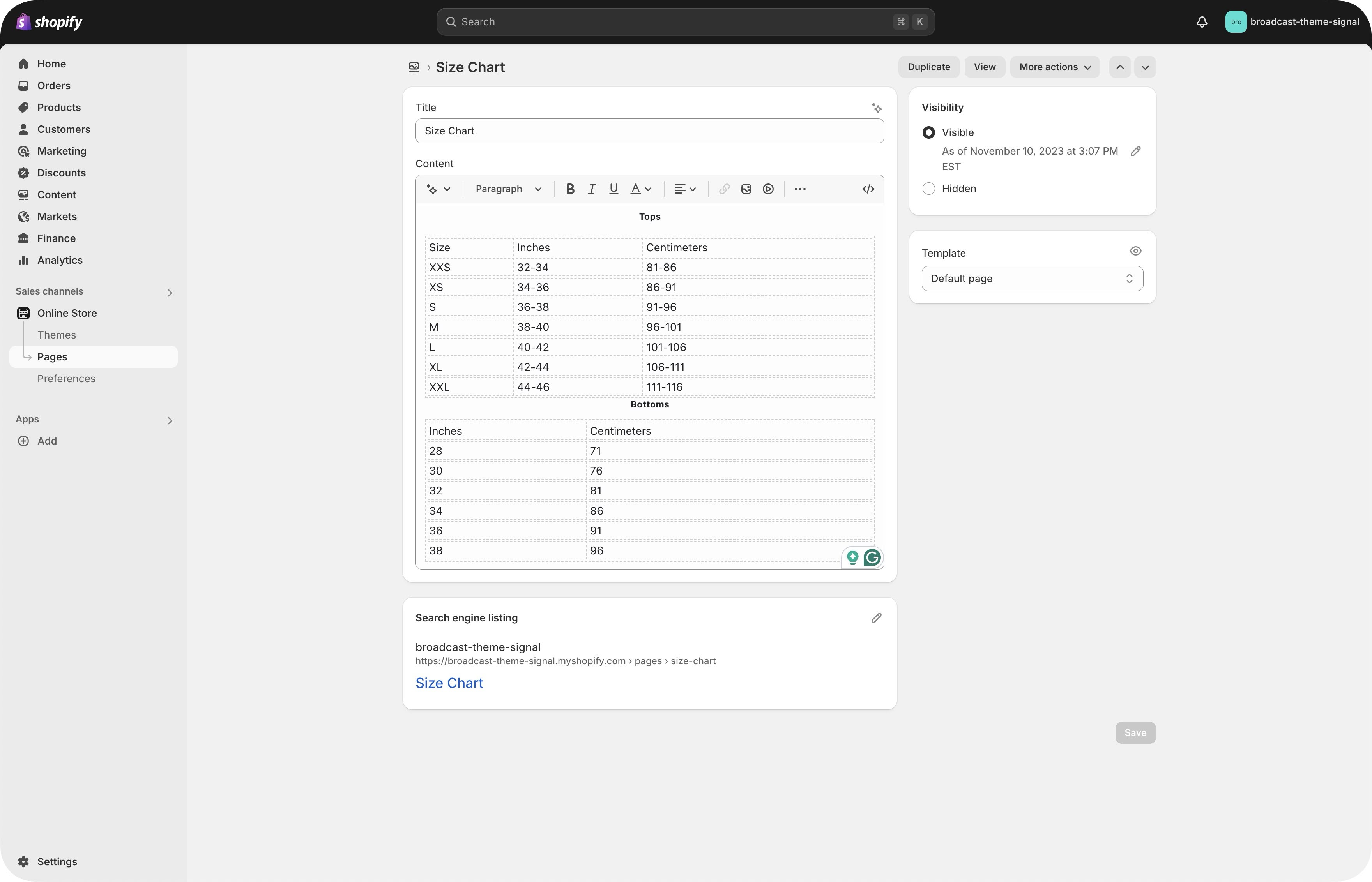
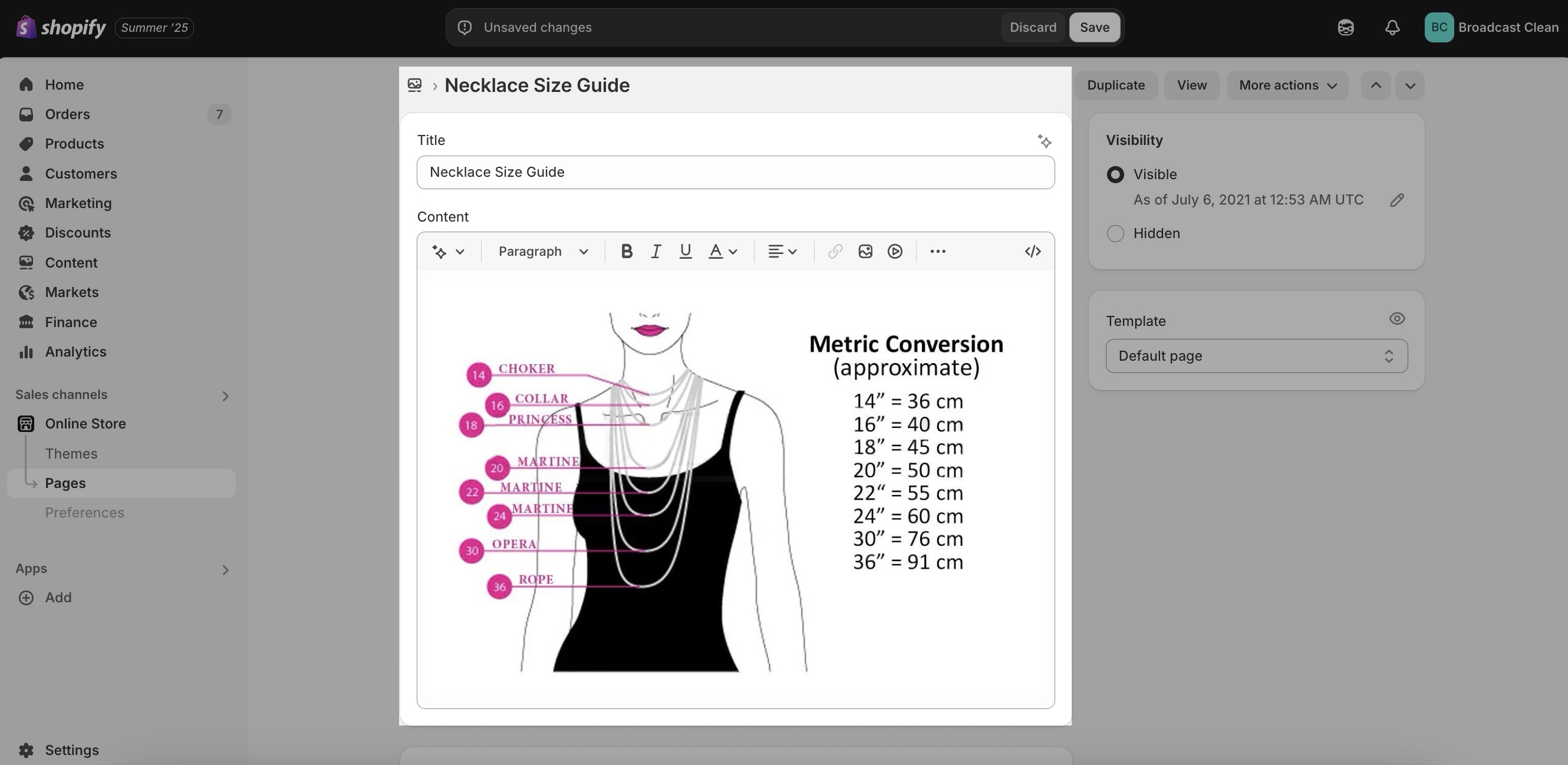
To start, you'll need to create your size chart pages. Broadcast will utilize Shopify's built-in Pages feature to display the size charts. If you already have an image of your size charts, you can simply upload it to a Shopify page.
### Step 1: Create your size chart pages
Begin outside of the Theme Customizer, in the main Shopify Admin. Navigate to:
Sales channels > Online store > Pages
* Choose the "Add page" button to create a new page.
* If you have an image already created for your size chart, add that to the content section of the page, or build a size chart page using the Shopify Rich Editor:
Example page with image
### Step 2: Create a reference metafield
(Easy) The next step is to define a Product metafield using Page as the reference type. Here's a quick video on how to create the Size Chart metafield:
{% embed url="" %}
#### Metafield reference from video
| Metafield details | | |
| ----------------- | ------------------- | ------------ |
| Metafield type | Product | |
| Name | Size Chart | |
| Namespace and key | `custom.size_chart` | |
| Description | Size Chart | |
| Type | **Page** | **One page** |
#### Screenshot
### Step 3: Set up products
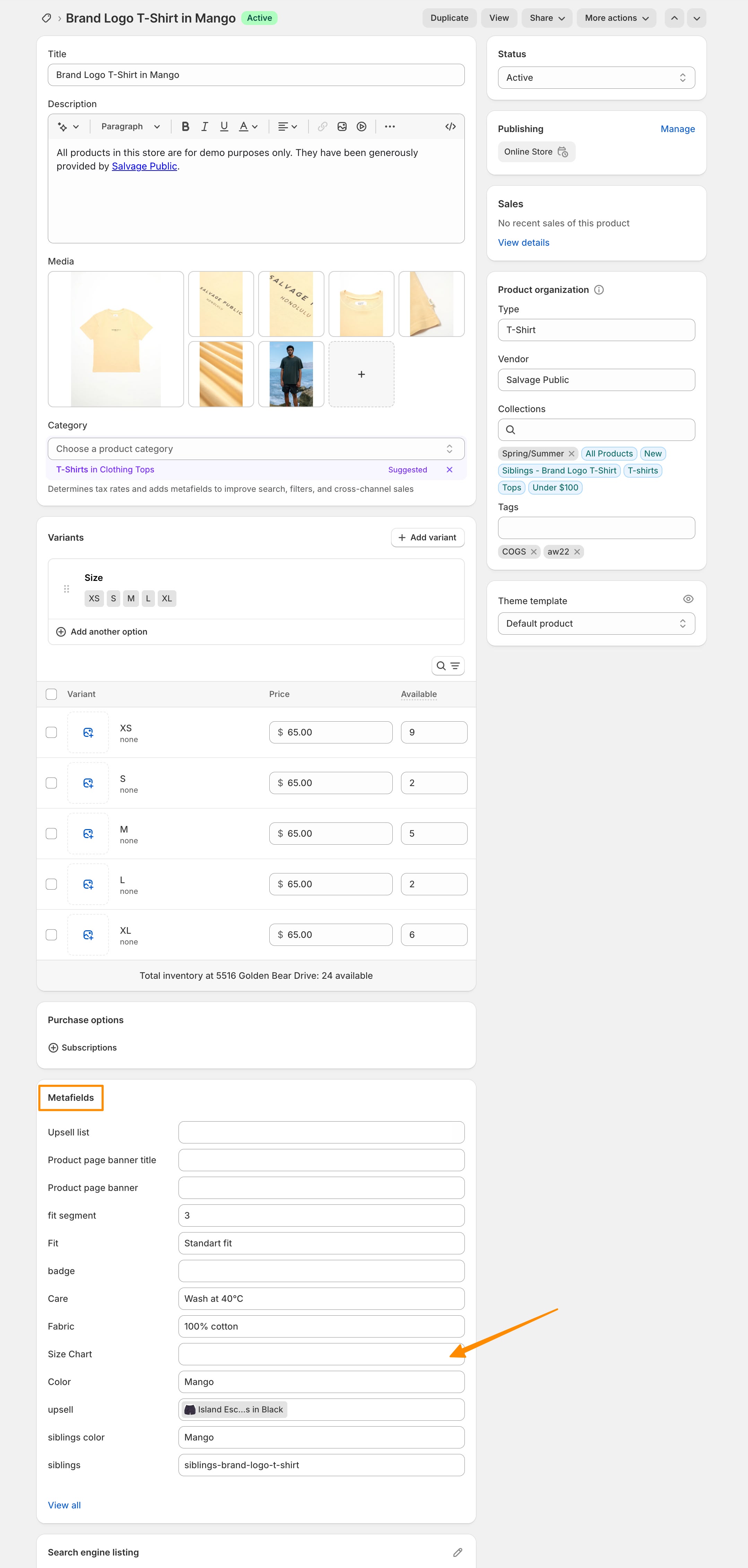
Your products will now have a Metafields section at the bottom. Use this to select which size chart page should be displayed when a customer is viewing this product.
* Choose the size chart page from Step 1 to associate with this product:
Choose a Size Chart Page for each individual product
{% hint style="success" %}
**Complete for all products**\
Ensure that you select a size chart page for each of your products. If the metafield is left blank, no size chart will be displayed.
{% endhint %}
### Step 4: Theme Customizer, connect the metafield
Next, we can use the Theme Customizer to activate the Size Chart metafield. There's one quick step to tell Broadcast to use the metafield you created in Step 2.
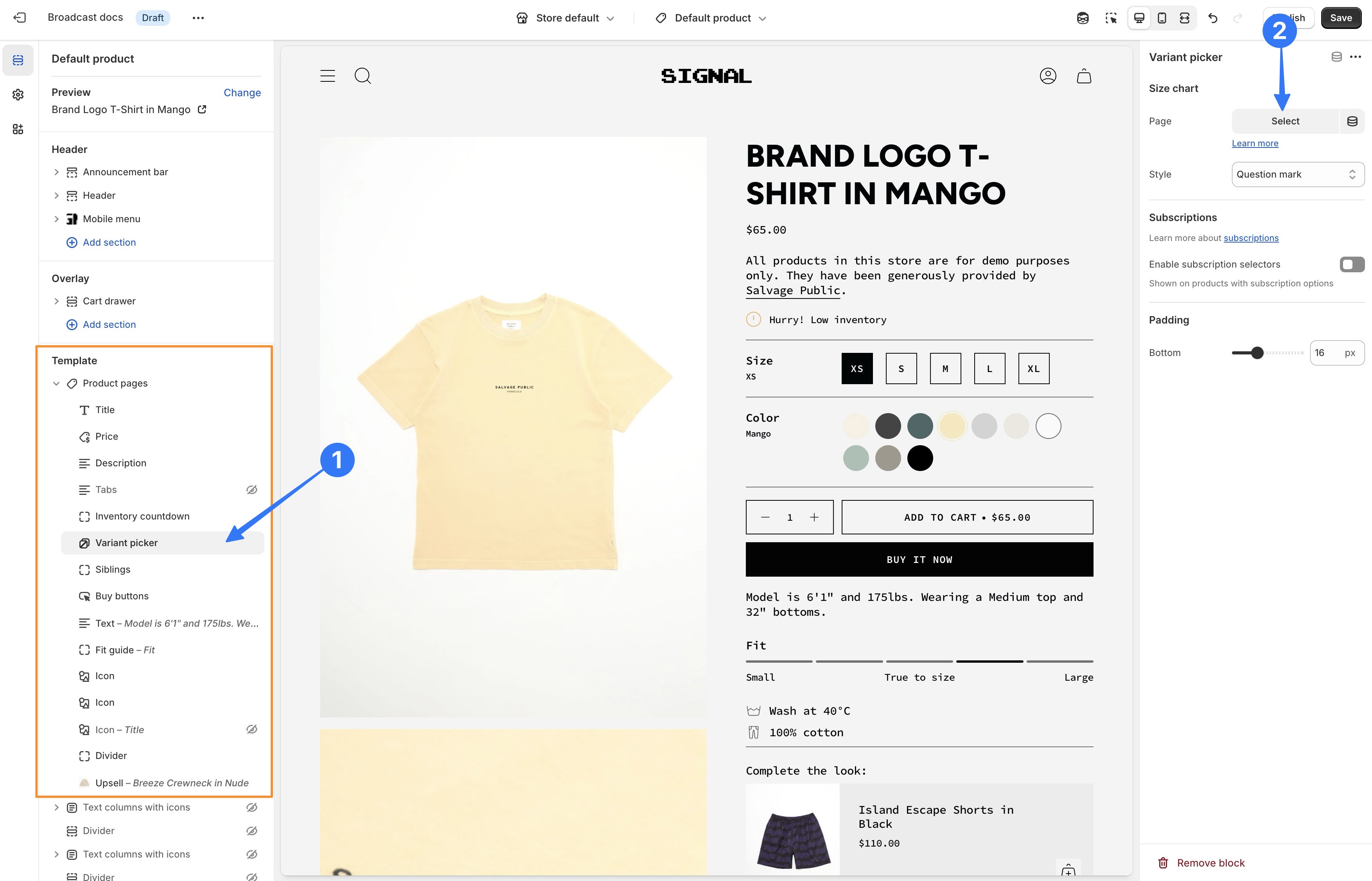
* Select your Product template, such as "Default product", in the Theme Customizer.
* On the left sidebar, under Template, expand "Product pages" and then choose "**Variant picker**"
* Use the dynamic data icon to select your Size Chart metafield.
#### Video for Step 4
Here's a short video on the above steps:
{% embed url="" %}
Your theme will now use unique size charts that you created in Step 1 and mapped to individual products in Step 3.
### Final notes
If you're not seeing the link for a size chart, make sure that the product you're viewing has a size chart page linked under the Metafields section. See Step 3.
If all steps are correct and you're still not seeing the link, exit the Theme Customizer and re-enter. Sometimes, the Shopify platform requires that step to force a refresh.
***
## How to use one chart for all products
If your store requires only **one** size chart for all product pages, you can skip steps 2 and 3 and simply choose the page in the Theme Customizer under Product pages > Variant picker.
One size chart for all products
**Tip**: You can use multiple product templates and assign one chart to each template. Then assign groups of products to each of the product templates.
---
# Agent Instructions
This documentation is published with GitBook. GitBook is the documentation platform designed so that both humans and AI agents can read, navigate, and reason over technical content effectively. Learn more at gitbook.com.
## Querying This Documentation
If you need additional information that is not directly available in this page, you can query the documentation dynamically by asking a question.
Perform an HTTP GET request on the current page URL with the `ask` query parameter, and the optional `goal` query parameter:
```
GET https://broadcast.presidiocreative.com/products/product-pages/size-charts.md?ask=&goal=
```
`ask` is the immediate question: it should be specific, self-contained, and written in natural language.
`goal` is optional and describes the broader end goal you are ultimately trying to accomplish on behalf of the user. GitBook uses it to tailor the answer towards what is most useful for that goal.
The response will contain a direct answer to the question and relevant excerpts and sources from the documentation.
Use this mechanism when the answer is not explicitly present in the current page, you need clarification or additional context, or you want to retrieve related documentation sections.




 to select your Size Chart metafield.