> For the complete documentation index, see [llms.txt](https://broadcast.presidiocreative.com/llms.txt). Markdown versions of documentation pages are available by appending `.md` to page URLs; this page is available as [Markdown](https://broadcast.presidiocreative.com/broadcast-v5/sections/broadcast-sections/newsletter.md).
# Newsletter
Add a quick and simple newsletter sign-up form to any page
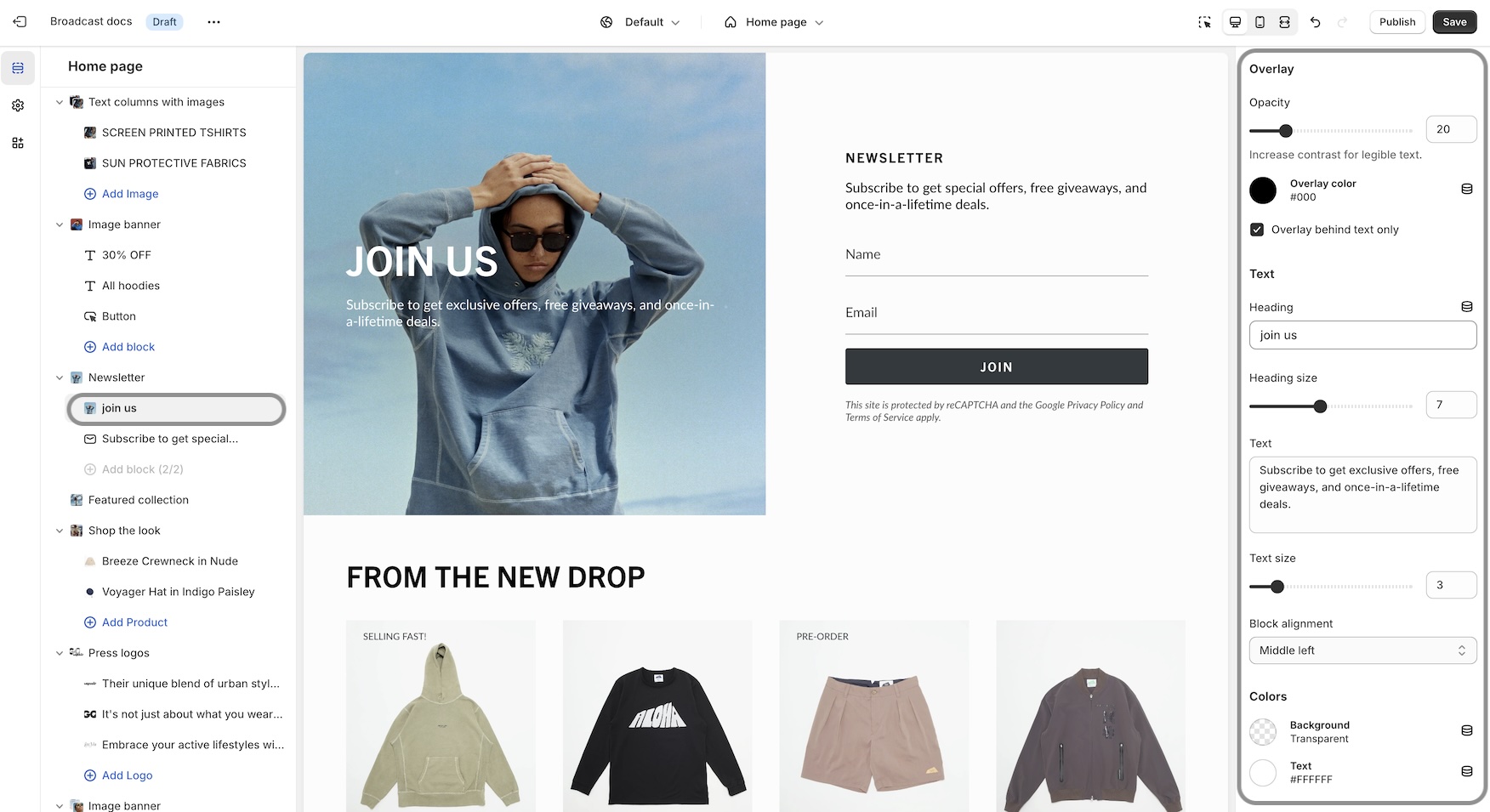
Broadcast provides various methods for adding a newsletter sign-up option to your shop, including the footer and blocks in various sections. This section allows you to promote your newsletter on any page easily.
The newsletter form collects the customer's email address and tags them in your customer base with "Accepts Marketing." When integrated with newsletter apps, you can target these customers with updates. New subscribers will be seen as new Customers in your Shopify admin tab.
### Flexible
Add the newsletter section to product pages, blog posts, or any page in your store. The image block lets you brand the promotion and increase awareness of your newsletter.
### Customize
* Use the image and sign-up blocks to build your promotion.
* Adjust the section height for both desktop and mobile devices.
* Width, padding, colors and section padding are available to complete the layout and style.
* Text can be overlaid on an image and positioned in various locations:
### Sending Newsletters
A third-party app from the Shopify App Store will be required for automated emails and the creation of custom mailing lists. The newsletter sign-up forms in all Shopify Themes can only collect the customer's email address and name. Apps help you build newsletters, add mailing lists, and automate sending messages to customers who have signed up.
Shopify email marketing apps can be found here:
{% embed url="" %}
Shopify App Store
{% endembed %}
Or search with this query:
{% embed url="" %}
Shopify App Store
{% endembed %}
---
# Agent Instructions
This documentation is published with GitBook. GitBook is the documentation platform designed so that both humans and AI agents can read, navigate, and reason over technical content effectively. Learn more at gitbook.com.
## Querying This Documentation
If you need additional information that is not directly available in this page, you can query the documentation by asking a question.
Perform an HTTP GET request on the following URL with the `ask` and `goal` query parameters:
```
GET https://broadcast.presidiocreative.com/broadcast-v5/sections/broadcast-sections/newsletter.md?ask=&goal=
```
`ask` is the immediate question: it should be specific, self-contained, and written in natural language.
`goal` is what the user is ultimately trying to achieve, the reason they need the answer. Sharing it helps GitBook give you a better, more relevant answer. A goal is most helpful when it describes the outcome the user wants rather than restating the question. For example, with `ask=how do I create an API token`, a goal like `automate deployments from our CI pipeline` lets GitBook tailor the answer to that use case.
The response will contain a direct answer to the question and relevant excerpts and sources from the documentation.
Use this mechanism when the answer is not explicitly present in the current page, you need clarification or additional context, or you want to retrieve related documentation sections.